NHC. Bolotnaya square trials are political and should be dropped

Photo: Rustam Adagamov

On 8 October 2013, Mikhail Kosenko, one of the defendants in the so-called Bolotnaya square case was found guilty of taking part in mass disorder (article 212 of the Russian Criminal Code) during the “March of the Millions” on 6 May 2012. The Zamoskvoretsky Regional court also found him guilty of physically assaulting police officers (article 318 of the Criminal Code) . – The Norwegian Helsinki Committee is critical of the trial, which did not comply with fair trial standards, said Gunnar M. Ekeløve-Slydal, Deputy Secretary General. – The conclusions of the court were not backed by solid evidence. Two police witnesses were unable to identify Kosenko as a person who had been involved in any violence. In the photo, Aleksandra Dukhanina, another of the victims from Bolotnaya awaiting trial is arrested. 

Mikhail Kosenko

The court sentenced Kosenko to psychiatric treatment, due to his registration as a disabled person for more than ten years. – This might be part of an alarming trend returning in Russia and some other former Soviet countries to use psychiatric treatment as a tool to punish political opponents or others disliked by the authorities, Ekeløve-Slydal continued. – There is considerable reason to doubt the conclusion that Kosenko pose a threat to society.

Kosenko has been detained for more than a year, and during this period he was not allowed to attend the funeral of his mother. – Kosenko was kept in pre-trial detention for a protracted period before trial in poor conditions, said Ekeløve-Slydal. – This is illustrative of how Bolotnaya square defendants have been treated.”

Court cases against Bolotnaya square demonstrators are still ongoing, while excessive use of violence by security services so far has not been investigated. – The Norwegian Helsinki Committee is concerned about the situation for the accused demonstrators, said Ekeløve-Slydal. – They are facing from eight to 13 years of imprisonment. It seems that the judicial process serve the purpose of threatening the opposition into passivity. The judiciary is clearly being used to stifle opposition. Norwegian and European authorities should demand that political trials stop and that Bolotnaya square and other political prisoners be released.

Background: Bolotnaya square case

The case against Bolotnya Square demonstrators originally included 27 people; however one of the accused has committed suicide. Defendants were accused of taking part in mass disorder, assaulting police officers and disobeying police instructions.

Dukhanina during court hearing. Photo: Dmitry Borko

According to the newspaper Novaya Gazeta, which monitors the trials, none of the witnesses from the security services have told of arson attempts, destruction of property or of armed resistance from the part of the demonstrators. On the contrary, they witness how they themselves were prepared to detain the participants in a coordinated action against “improper” slogans and posters.

The organizers had sought approval of authorities for organizing the event but this did not prevent the demonstration from being dissolved by the police. About 600 persons were arrested, including opposition leaders Alexey Navalny, Boris Nemtsov and Sergey Udaltsov.

The Bolotnaya square rally followed a series of peaceful protests prompted by allegations of electoral fraud at the December 2011 parliamentary elections, won by United Russia – a party loyal to Putin.

According to eye witnesses, the police suddenly blocked the way to Bolotnaya square where the sanctioned rally was planned to take place, thus provoking a clash with the protesters. The police announced that the rally had been cancelled and immediately attacked the protesters; beginning to disperse protesters violently using truncheons and special equipment and weapons (for more information, consult: http://6may.org/en/).

Brutal crackdown on peaceful demonstrators. Photo: Rustam Adagamov

Putin’s only comment on the Bolotnaya square case has been to say that violence against police is unacceptable. Senior United Russia lawmakers have said the clashes were financed from abroad as “a provocation”, citing a dubious documentary broadcast on state TV that claimed to show opposition leaders and a Georgian politician plotting the clashes.

The Norwegian Helsinki Committee follows the trials and the situation of some of the defendants (for more information on the defendants, see Wikipedia article on the Bolotnaya square case,http://en.wikipedia.org/wiki/Bolotnaya_square_case). Four of the defendants are women. Alexandra Dukhanina faces 13 years of imprisonment. Waiting for her trial, she has been placed under house arrest for over a year.
NHC

Bolotnaya trial: man sentenced to indefinite psychiatric treatment

Mikhail Kosenko convicted despite footage showing he was not violent during anti-Putin protests in Bolotnaya Square last year.

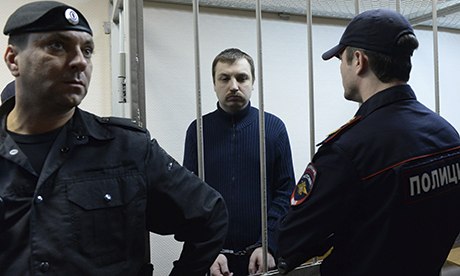
Mikhail Kosenko has been convicted for ‘calling for mass riots’ on the eve of president Vladimir Putin’s inauguration. Photograph: Vasily Maximov/AFP/Getty Images

A Moscow court sentenced a 37-year-old man to an indefinite term of forced psychiatric treatment on Tuesday in a case that rights activists say was fabricated and part of a crackdown on the street protest movement that has emerged in the past two years.

Mikhail Kosenko was one of 28 people arrested after clashes during a rally in central Moscow last year, the day before Vladimir Putin was inaugurated for a new presidential term. Although police officers were injured, the court heard that Kosenko was not involved in the violence.

The conviction for “calling for mass riots” came despite video footage showing Kosenko as a bystander to scuffles between police and protesters. Additionally, the officer named as the victim in the case, Alexander Kazmin, refused to identify Kosenko as the person who attacked him. “I do not know this person,” he told the court during a hearing over the summer.

The trials of those arrested over the scuffles on 6 May 2012 have become known as the Bolotnaya affair, after the square in which the clashes took place. Late last year, Maxim Luzyanin was jailed for four-and-a-half years for his part in the protest, while a further 26 people face sentences of up to 13 years if convicted of taking part in, or provoking, mass disturbances.

Putin said recently he could not rule out an amnesty of those involved in the case, which analysts say has been pursued with such zeal in order to discourage street protests against the regime.

Kosenko’s case has appalled rights activists who say it is unclear why he was held separately in psychiatric carewhile awaiting trial, a punishment that echoes the Soviet practice of confining dissidents to mental institutions. He was not even allowed out to attend the funeral of his mother.

Kosenko suffers from a psychiatric disorder that resulted from concussion sustained during his military service but has received outpatient treatment for more than a decade and has never fallen foul of the law.

Nevertheless, the court decided he was not of sound mind and ruled that he should be confined to a psychiatric ward. During his final words to the court Kosenko said he was of sound mental state. Amnesty International has declared him a prisoner of conscience.

In the packed courtroom, Judge Ludmila Moskalenko murmured her way through the verdict for two hours, her voice frequently drowned out by chants of “freedom” from hundreds of people gathered in the street outside.

“If someone has committed a terrible crime and is not mentally stable, then there is nothing wrong with psychiatric treatment,” said Oleg Orlov, chairman of Memorial, a leading human rights organisation, outside the court. “But in Kosenko’s case, the evidence proved absolutely 100% that this man had nothing to do with the crimes he is accused of. He did not hit or kick anyone.”

Orlov added that he had grave doubts about whether Kosenko’s medical condition required forced treatment, given he had been living a normal life for years.

Those present to show their support for Kosenko included members of the protest movement who had been at Bolotnaya Square on the day of the protest as well as a number of older Soviet-era dissidents, some of whom had been subjected to forced psychiatric treatment. The veteran dissident and human rights campaigner Ludmila Alexeyeva left the courtroom in tears.

After sentencing Kosenko, the judge left the courtroom amid shouts of “Shame on you!” and “Send her to prison!”

Kosenko was led away in handcuffs by police to begin indefinite forced psychiatric treatment in a secure unit, until he is deemed to have “recovered”.

Shaun Walker in Moscow. The Guardian.

HRW. Russia: Withdraw Charges Against Protester

IMG_3534

Russian authorities should withdraw the charges against a protester on trial in relation to the 2012 mass protest. The protester, Mikhail Kosenko, faces indefinite detention in a psychiatric institution on charges of mass rioting and an act of violence threatening the life of an official.

Moscow’s Zamoskvoretski District Court is expected to deliver a verdict in the case against Kosenko on October 8, 2013. A prominent psychiatrist told Human Rights Watch that he considers the case a stark example of the use of psychiatry for political purposes.

“The Russian authorities should end the injustice against Kosenko,” said Tanya Lokshina, Russia program director at Human Rights Watch. “Kosenko should never have been forced to spend 16 months behind bars on grossly disproportionate charges, and now he faces indefinite, forced psychiatric treatment.”

The prosecutor should drop the charges against Kosenko, request his release from custody, and ensure that he is not under any circumstances sent for forced psychiatric treatment, Human Rights Watch said.

Kosenko, who has been in pretrial detention for 16 months, was one of tens of thousands of demonstrators who protested in central Moscow’s Bolotnaya Square on May 6, 2012, the day before President Vladimir Putin’s inauguration. There were scattered clashes between a small number of protesters and police.

Kosenko, who has a mental disability, is one of 25 people charged in relation to the protest. But he was tried separately because the prosecution is seeking his incarceration in a psychiatric institution for forced treatment.

Kosenko is accused of hitting a police officer, Alexander Kozmin, “at least once with his leg and once with his arm” during the protests and tearing off the officer’s protective gear. However, at Kosenko’s trial, which Human Rights Watch attended, Kozmin testified that he could not identify Kosenko as the man who hit him, and stated that he did not want Kosenko to be punished for a crime he did not commit. Another police officer testified that he did not remember Kosenko from the rally and could not recognize him on a video recording of the events.

Three prominent Russian human rights defenders who were standing near Kosenko when Kozmin was attacked also testified that Kosenko did not hit the policeman.

Human Rights Watch scrutinized the video recording the prosecution presented in court and could not find any indication that Kosenko took any part in the violent clash. Amnesty International has named Kosenko a “prisoner of conscience.”

The only witness who supported the prosecutor’s accusation was a policeman who said Kosenko “moved his hands in the direction of” Kozmin. The witness claimed that he recognized Kosenko in the video by the color of his clothes and hair.

“The majority of the evidence, including from the police officer himself, indicates that Kosenko never touched him,” Lokshina said. “The court heard nothing that would justify the charge of threatening the life of the official.”

Kosenko is also charged with participation in “mass riots,” whichunder Russian law involves “violence, pogroms, arsons, destruction of property, use of firearms and explosives, and putting up armed resistance vis-à-vis an official.” The prosecutor’s office filed the same charge against a number of Bolotnaya protesters, citing beatings of about 40 policemen, damage to police protective gear, destruction of six portable toilets, and an incident in which a Molotov cocktail broke against the road, setting a protester’s pants on fire.

The prosecutor contended that Kosenko acted unwillfully, claiming he was “mentally incompetent,” and asked the judge to commit him to forced confinement in a psychiatric institution.

In 2001 Kosenko was diagnosed with “sluggishly progressing [i.e. mild] schizophrenia.” Since then, his mental health has been regularly monitored by doctors, and he has been on medication. His sister told Human Rights Watch that Kosenko regularly and willingly took his medication, and never showed aggression, needed special assistance, or required hospitalization.

Kosenko had no police record before the Bolotnaya events. His sister and lawyers told Human Rights Watch that throughout his 16 months in custody, Kosenko showed no aggression toward prison staff and inmates, even after learning, through the media, about the death of his mother in September. Authorities did not allow Kosenko to attend her funeral.

In July 2012, forensic psychiatrists from the Serbsky Institute, Russia’s state psychiatric research center, evaluated Kosenko and diagnosed him with paranoid schizophrenia, a more serious condition that, they claimed, made Kosenko “a danger to himself and others.” They recommend confining him for psychiatric treatment.

In August 2012 Dr. Yuri Savenko, the head of Russia’s Independent Psychiatric Association, a Russian nongovernmental organization, told Kosenko’s lawyers that the Serbsky Institute’s evaluation was deeply flawed. Savenko, a prominent psychiatrist with 50 years of clinical practice, said that the Serbsky Institute experts overlooked 12 years of observations by Kosenko’s doctors, who clearly indicated in Kosenko’s medical history that he was not prone to aggression and had no violent episodes. He said the Serbsky Institute specialists also ignored the fact that Kosenko’s medications were very mild and that he had never required hospitalization.

Kosenko’s lawyers presented this evidence in court and petitioned the court to order the Serbsky Institute to carry out a new evaluation. The court dismissed the petition.

Dr. Savenko told Human Rights Watch that the Serbsky Institute’s assessment of Kosenko was “punitive” and specifically aimed at justifying forced treatment. “The case is emblematic of the use of psychiatry for political purposes,” Savenko said.

The United Nations special rapporteur on torture, Juan Mendez, specifically noted in his report to the UN Human Rights Council in March that “free and informed consent [for psychiatric treatment] should be safeguarded on an equal basis for all individuals without any exception. He also said that the “severity of the mental illness cannot justify detention nor can it be justified by a motivation to protect the safety of the person or of others” and that “deprivation of liberty that is based on the grounds of a disability and that inflicts severe pain or suffering falls under the scope of the Convention against Torture.”

“Kosenko has needlessly spent more than a year behind bars,” Lokshina said. “Committing him to forced psychiatric treatment would be a grave violation of his rights.”

HRW